Most organizations still search for information as if the problem were finding words. In 2026, that is no longer the problem.
The real problem is different: the company has the information, but cannot retrieve it at the right moment, in the right context, or in the form a decision actually needs it.
That is not solved with a prettier search interface. It is solved with a different architecture. Because between having documents and being able to operate with them there is an enormous gap: scattered repositories, inconsistent naming, redundant documents, unstructured tickets and manuals, keyword searches that return literal matches but not meaning.
Weaviate puts it well: vector search looks for similarity by comparing vector representations, rather than relying on exact matches. That difference, for a CTO or a CDO, is not cosmetic. It is architectural.
The most common mistake: thinking semantic search is just "RAG for chat"
When they hear "embeddings," many companies think chatbot over documents, internal assistant, PDF search, or FAQ with AI. That is barely a fraction of the picture.
Vectors and embeddings are not a chat feature. They are a fundamentally different way of representing information so it can be compared, clustered, filtered, and retrieved by semantic proximity.
FAISS defines its own focus as similarity search over dense vectors at scale, including collections that may not fit entirely in memory. That means the problem is not just "answering questions." It can also be:
- Finding operationally similar incidents
- Detecting related documentation even when it shares no exact words
- Retrieving similar root causes
- Associating tickets, manuals, and logs under a shared semantic pattern
- Enabling agents and copilots with genuine grounding
- Improving support, engineering, compliance, or after-sales workflows
Reducing embeddings to "chat with documents" is like reducing a relational database to "a nice-looking table."
What an embedding actually is
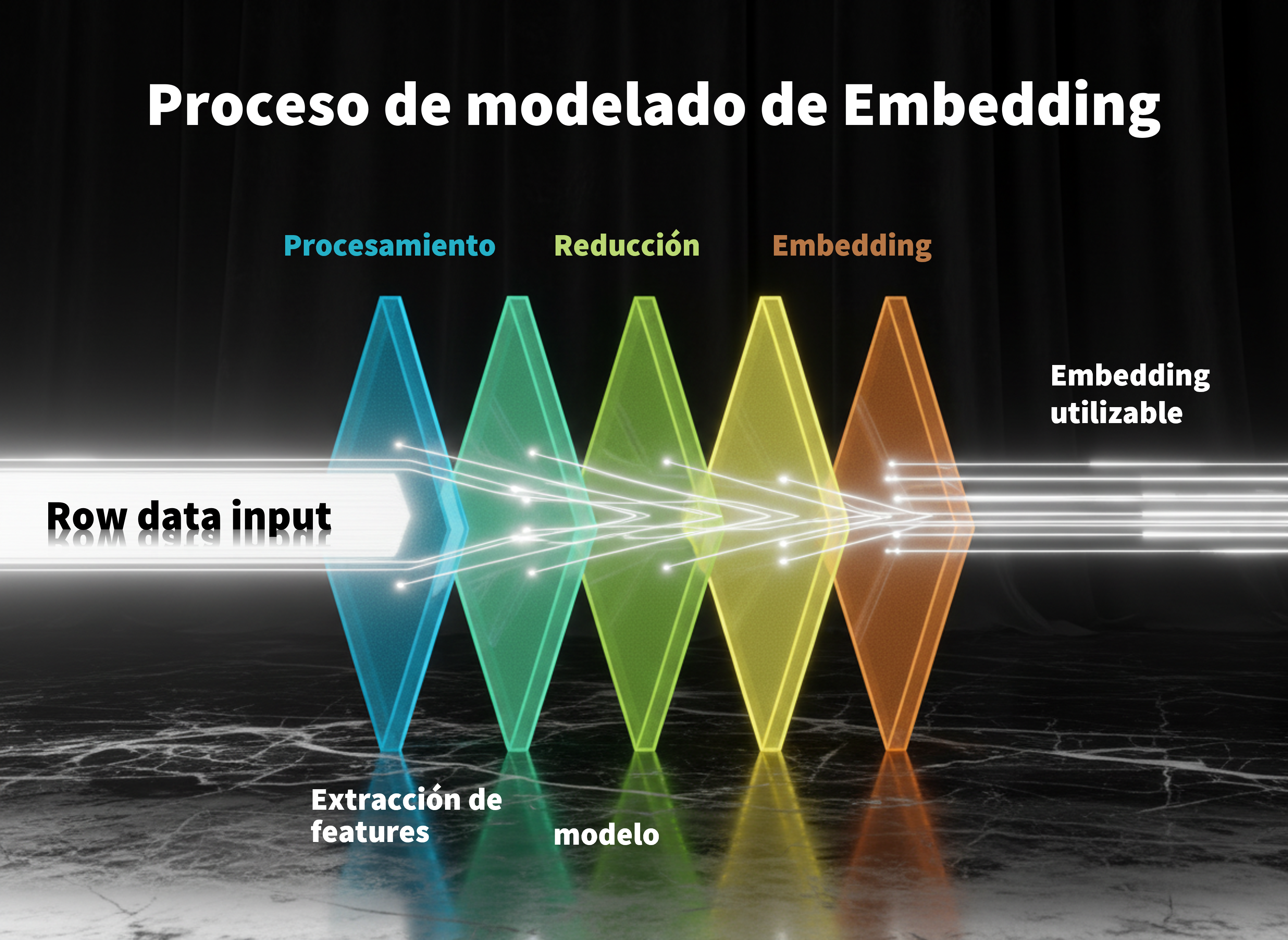
An embedding is a numerical representation of a piece of content in a vector space. If two texts, events, or fragments carry similar meaning, their vectors end up close to each other.
OpenAI describes its embedding models precisely as a way to convert text into vectors for use cases such as search, clustering, recommendation, and retrieval.
That matters because it completely changes the logic of search. Keyword search asks: "Does this document contain exactly the words I typed?" Vector search asks: "Which documents are closest, in meaning, to what I need to find?"
That shift sounds technical. In reality, it changes how an organization interacts with its own memory.
What is broken today: the company already has context, but cannot activate it
In a complex organization, knowledge is rarely absent. What is absent is the ability to activate it in time.
You see it everywhere: an operations team repeats an analysis that was already done six months ago; support cannot find the most similar incident because it was described with different terminology; compliance fails to retrieve the right policy because the search engine does not understand synonyms or context; an agent finds documents but not the most useful ones; a copilot summarizes garbage because the upstream retrieval was poor.
The company does not operate without information. It operates without reliable retrieval of meaning. And that is where embeddings and vector search stop being an "AI topic" and become decision infrastructure.
The 2026 shift: indexing is no longer enough — you have to design retrieval
OpenAI makes this explicit in its file search: the system does not just vectorize — it also parses, chunks, and combines vector search with keyword search to improve retrieval.
That detail matters far more than it seems. Because the value does not live in the embedding model alone. It lives in the complete retrieval system: chunking, metadata, filters, ranking, the blend of semantic and lexical matching, data freshness, and source traceability.
Pinecone reflects this too when it differentiates between more managed assistants and vector stores where you control the embedding model, chunking strategy, and search approach, including hybrid modes. The lesson is direct: semantic search is not implemented by buying a vector DB and uploading files. It is implemented by designing how useful context is retrieved for a real decision.
The right question is not which vector DB to use. It is what type of retrieval you need
The market conversation usually starts badly: Pinecone or Weaviate, FAISS or Milvus, cloud or on-prem. That comes too soon. Before talking engines, a company should answer four questions:
Searching full documents is not the same as searching technical fragments, tickets, logs, policies, analogous incidents, or cross-referenced manuals and RCAs. Each content type has different chunking, metadata, and retrieval strategy requirements.
A search for an analyst is not the same as a search feeding an agent or a real-time operational flow. The infrastructure requirements are completely different.
In production, almost no serious search is "vector only." It typically needs filters by team, date, area, site, severity, version, customer, or language. Without well-designed metadata, the search produces noise even when the embedding is good.
Multi-tenancy, auditing, region, encryption, access controls, and isolation matter far more once this moves beyond demo. Pinecone already documents multitenancy with namespaces, CMEK, audit logs, BYOC, and data freshness: the 2026 market does not treat this as a lab experiment.
Keyword search is not going away. The serious pattern is hybrid
Another frequent mistake is presenting vector search as an absolute replacement for traditional search. There are cases where lexical matching matters enormously: equipment codes, incident IDs, exact procedure names, standard numbers, specific clauses, document versions.
That is why serious architecture in 2026 is rarely "semantic only." It is usually hybrid: vector search to retrieve by meaning, keyword or sparse search for literal precision, and reranking to surface what truly matters.
OpenAI already does this in file search, combining vector and keyword retrieval. The lesson is important: if your architecture forces a choice between keyword and semantic, you are probably designing something too simple for the real problem.
Where embeddings actually capture value
The most mature organizations do not implement embeddings "to have semantic search." They implement them where they remove a concrete friction.
- Similar incidents even when described with different terminology
- Related runbooks and previously useful tickets
- Relevant resolutions without literal text matches
- Cross-referencing manuals, RCAs, failure reports, and procedures against real field questions
- Retrieval by operational pattern, not just by keyword
- Policies, clauses, controls, or standards relevant by intent
- Semantic retrieval that survives terminology changes across document versions
- Without good retrieval, the LLM does not fail because of "intelligence." It fails because of grounding
- RAG quality depends more on retrieval than on the model
This is where Yaripo holds a strong thesis: embeddings are not just for text. They can be a way to represent operational memory.
What almost everyone underestimates: chunking and metadata
There are two decisions that destroy more semantic search projects than choosing the wrong model.
Poor chunking. If you split content badly, you destroy context before you can search it. A fragment cut in the middle of a concept produces low-quality embeddings that retrieve meaningless results.
Useless or absent metadata. If you do not tag by site, system, date, document type, criticality, or version, you cannot govern or filter retrieval later. That point is just as important as choosing a vector DB.
Semantic search without good chunking retrieves meaningless fragments. Semantic search without metadata produces elegant noise. Both fail even when the embedding model is excellent.
FAISS, Weaviate, Pinecone: what they actually represent in 2026
Rather than talking brands, what is useful is understanding the role each one plays:
The reference for efficient similarity search over dense vectors, especially when you want control over algorithms and performance. Supports metrics such as inner product and L2.
Packages vectorization, search, and production-ready layers more tightly, with an AI-application-oriented experience from the ground up.
Enterprise-managed focus: multi-tenancy, audit logs, backups, serverless, and governance controls from day one.
How much control you need, how much you want to manage yourself, what governance requirements you have, and how production-ready it must be from day one.
What an enterprise should decide before deploying embeddings in production
A serious implementation should be able to answer these questions before moving to build:
Not every repository should be vectorized without criteria. Define which sources, which versions, and what refresh cadence before indexing.
Embedding model, version, language, useful context length, and update cost. The model is not interchangeable once you have indexed millions of fragments.
Chunk size, overlap, and respect for the document's logical structure. A technical manual is not chunked the same way as a support ticket.
Minimum required metadata and access rules. Without this, retrieval cannot be governed or audited.
Not "it feels right." With test queries, relevance, precision, and noise rate measured before connecting this to an agent or production flow.
What happens when content changes, is deleted, or is versioned. A stale index produces stale answers even when retrieval works correctly.
Who retrieved what, from where, and under which permissions. That is the point where embeddings stop being an experiment and become infrastructure.
Yaripo's position
Most of the market still presents embeddings as a subordinate piece of RAG. That is far too narrow.
Vectors and embeddings are something more important: a new layer for representing and retrieving organizational memory by meaning. That changes how a company searches, how an agent is grounded, how documentation connects to operations, how repeated work is avoided, and how the cognitive cost of decision-making is reduced.
Do not look at embeddings as a technical trend, but as architecture for an organization to stop depending on keywords, folders, and scattered human memory.
Because in 2026 the advantage is no longer in having more documents. The advantage is in retrieving the right context before everyone else, exactly when operations need it.
Most organizations already have the knowledge they need. What they lack is an architecture capable of retrieving it by meaning, with context, filters, and traceability. And that is the difference between companies that search and companies that actually find.
The question is not whether you should use embeddings. The question is: is your organization still searching like a document repository, or have you started designing retrieval as a strategic capability?